Ice maker repair in Staten Island, NY covers residential fridge ice makers that have stopped making ice, are making small or hollow cubes, are leaking, are jammed, or are making bad tasting ice. This page is about the ice maker inside your fridge only.
Ice Maker Not Making Ice
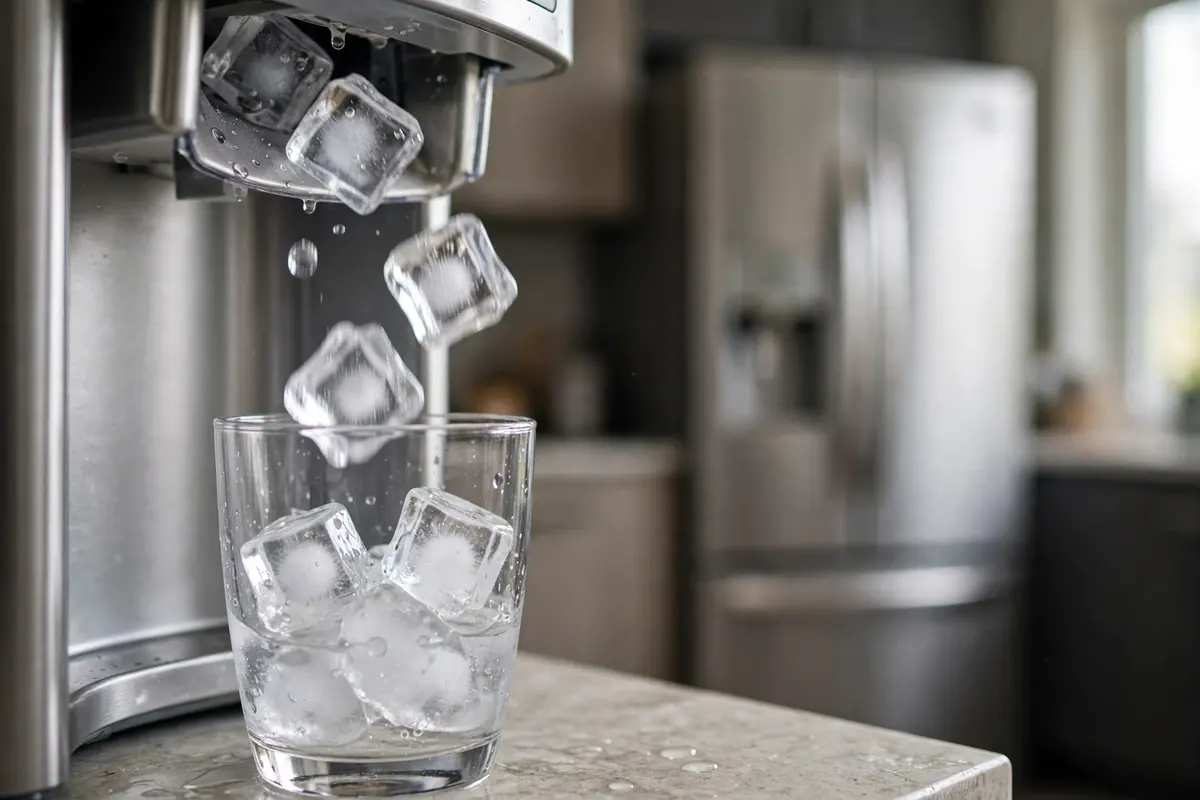
First, check that the ice maker is switched on. On many models the control is a switch, a wire arm, or a display setting. Next, check that the freezer is cold enough, usually at or near 0 degrees Fahrenheit. Then check the water supply by trying the dispenser, if your fridge has one. If the dispenser is slow or gives no water, the supply is the likely problem. Also check the water filter, since an overdue filter can slow flow enough that the ice maker cannot fill.
Small or Hollow Cubes
Small or hollow cubes usually point to low water flow. The tray is not getting enough water, so each cube freezes thin or hollow. The usual causes are a clogged filter, low water pressure, a blocked fill tube, or a valve that does not open fully. Check the filter first. Check that the water supply valve behind the fridge is fully open. If the cubes stay small after a filter change, the fill tube or the inlet valve needs testing.
Ice Tastes Bad or Smells Bad
Bad tasting ice usually picks up the taste from the water or from the freezer. First, check the water filter. An overdue filter can let taste and odour through. Second, check what is stored near the ice bin, since ice absorbs odours from food. Remove old ice, clean the bin, dry it fully, and let the ice maker make a fresh batch. New York City water is soft, at about 1.8 grains per gallon, so hard water scale is not the usual cause here.
Ice Maker Leaking
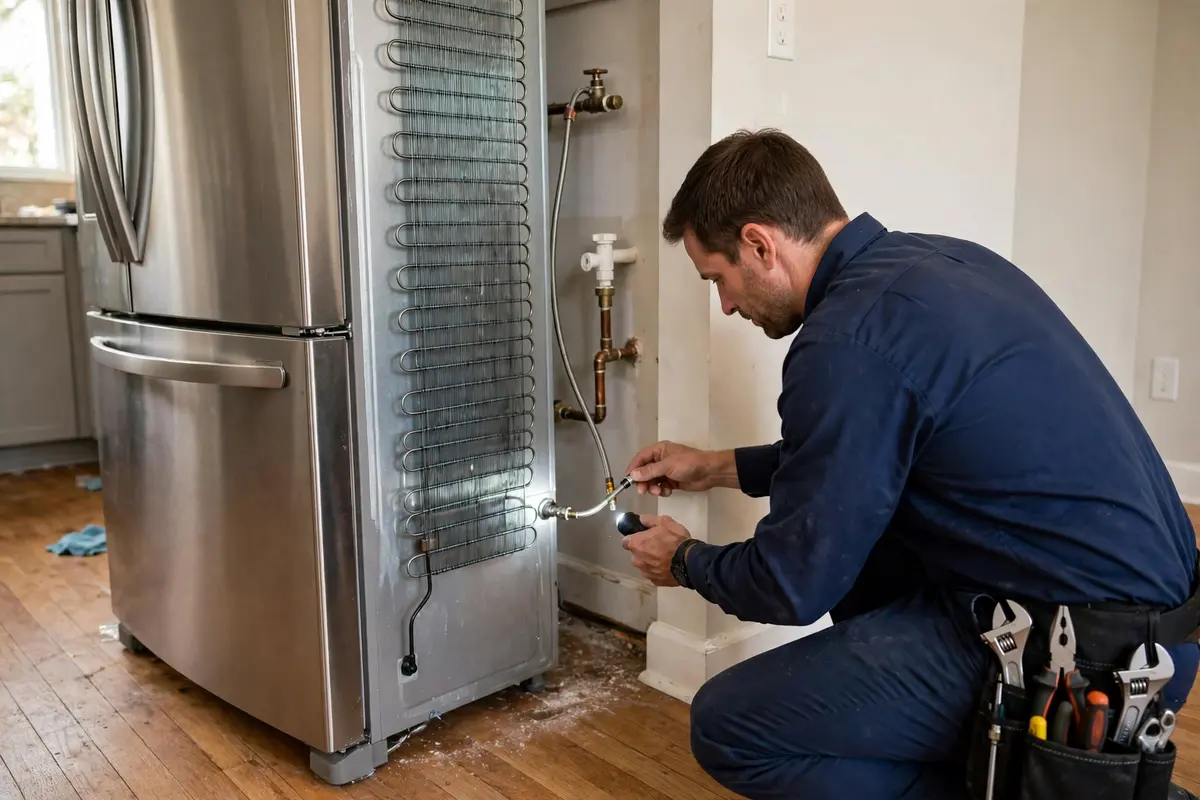
A leak can show up as water on the floor, water inside the freezer, or ice on the freezer floor. Water on the floor near the back often comes from the supply line or the inlet valve. Water inside the freezer often comes from a frozen fill tube, or from a valve that does not shut off fully. If you can find the water shutoff valve, turn it off and mop up the water. Do not ignore a small leak, since water can damage flooring and cabinets.
Ice Maker Jammed
A jam usually means the ejector arm cannot move, or cubes are stuck in the tray. The most common cause is ice that has frozen together in the bin or tray. Try removing the ice bin, if your model allows it, and clearing fused cubes by hand. Do not use a knife or screwdriver to chip ice out of the tray, since the tray can be damaged easily. If the jam keeps coming back, the cause may be a freezer temperature problem, a weak door seal, or a module that does not harvest cleanly.
Ice Maker Noisy
A loud buzzing sound can mean the inlet valve is trying to open but no water is reaching it. A grinding sound can mean the ejector arm is hitting ice. A repeated clicking sound can mean the module motor is struggling to complete a cycle. Note when the noise happens, since that points to the cause.
What Causes Each Problem
- No ice: the ice maker is off, the freezer is too warm, the filter is clogged, the fill tube is frozen, the valve has failed, or the module has failed.
- Small or hollow cubes: low water flow, a clogged filter, a blocked fill tube, or a valve that does not open fully.
- Bad tasting ice: an overdue filter, odours in the freezer, or a water supply problem.
- Leaking: a cracked supply line, a loose connection, a frozen fill tube, or a valve that does not shut off.
- Jammed: fused cubes, a freezer temperature problem, or a module that does not harvest cleanly.
- Noisy: a valve with no water, an ejector arm hitting ice, or a struggling module motor.
Water supply, filter, fill tube, module, and freezer temperature appear in almost every case. A technician will check all five.
What the Visit Looks Like
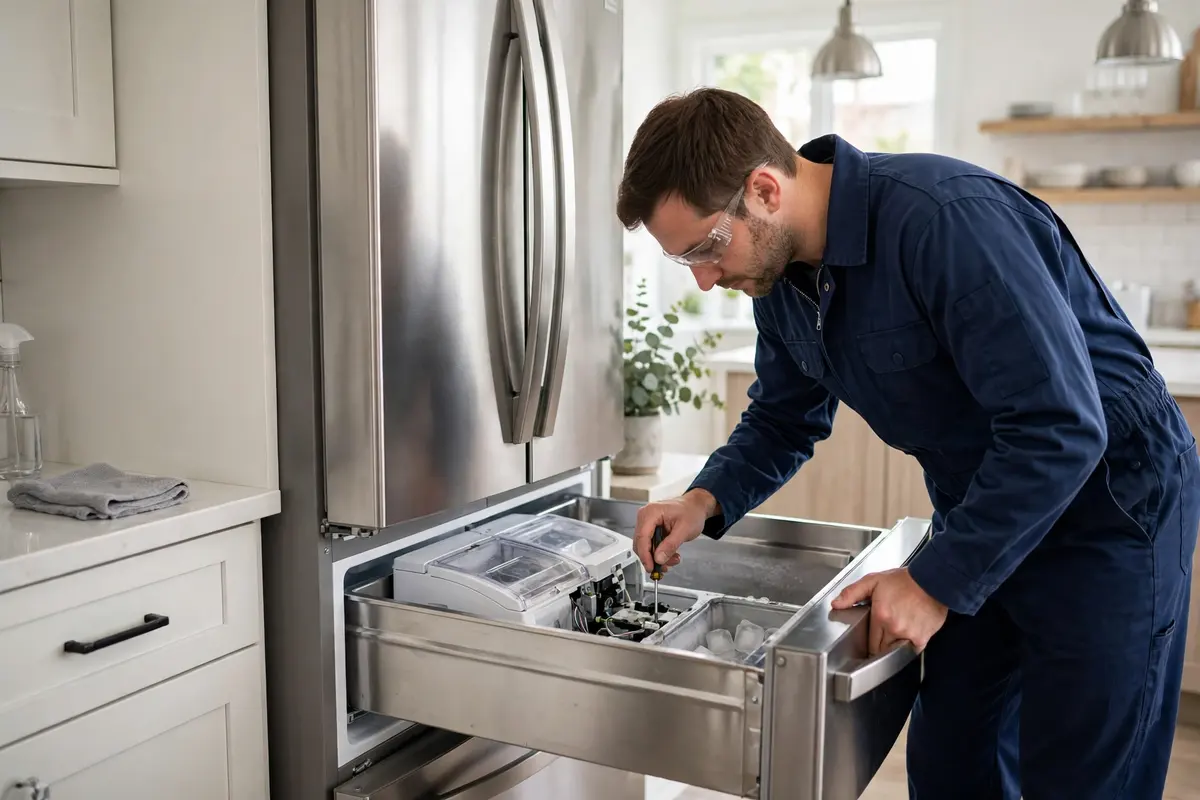
- Diagnosis. The technician checks the freezer temperature, the filter, the fill tube, the inlet valve, and the ice maker module. If the freezer itself is not cooling properly, the ice maker problem may be a symptom of a larger fridge fault.
- Written estimate before work. Once the fault is found, you receive a written estimate. No work starts until you have seen it and agreed to it.
- Repair or part ordering. If a part has to be ordered, ask for the part name and timing in writing. The diagnostic fee is $80 for standard brands and $95 for elite and premium brands.
Repair vs Replace: Ice Maker or Whole Fridge
The question has two levels. The first is the ice maker itself. A module, valve, or fill tube is a smaller repair than a whole fridge, and for a fridge that is otherwise working well, repairing the ice maker is usually the practical choice. The second is the whole fridge. If the freezer is not cooling properly, or if the fridge is old and has had several major repairs, the question becomes whether the fridge itself is worth repairing. Use the 50 percent rule as a screen: if the repair would cost more than about half the price of a comparable new fridge, and the fridge is past the midpoint of its expected life, replacement is usually the better choice. A refrigerator has an expected life of about 15 years. A fridge under 8 years old in good condition is often worth repairing. A fridge over 15 years old, or one that needs a sealed system repair as well, is often a better candidate for replacement.
Cost Factors
No prices are published here, because the cost depends on the fault and the part.
- Diagnosis. The diagnostic fee is $80 for standard brands and $95 for elite and premium brands.
- Part. A module, valve, fill tube, and filter cost different amounts, as do original and aftermarket parts.
- Cause. A frozen fill tube is a different job from a failed module, and a warm freezer may need fridge work as well.
- Brand and model. Some ice maker parts are easy to source, and some take longer.
- Access. A fridge in a tight kitchen can take longer to move safely.
The warranty length is a 90-day parts and labor warranty.
Brands We Repair
We repair all major brands, including Samsung, LG, Whirlpool, GE, Maytag, Bosch, Frigidaire, KitchenAid, Kenmore, Sub-Zero, Viking, and Miele. No authorized dealer claim is made for any brand. Have your brand and full model number ready when you call.
Service Area
Ice maker repair is available across Staten Island, NY, in all 14 ZIP codes: 10301, 10302, 10303, 10304, 10305, 10306, 10307, 10308, 10309, 10310, 10311, 10312, 10313, and 10314. The business address is 205 Ridgecrest Ave, Staten Island, NY 10312. This business does not hold a licence. The business name is Staten Island Appliance Repair. To book a visit, call us.
Frequently Asked Questions
Why is my ice maker not making ice?
Check that the ice maker is switched on and the freezer is cold enough, usually at or near 0 degrees Fahrenheit. Then check the filter and water supply.
Why are my ice cubes small or hollow?
Small cubes usually mean the tray is not getting enough water, often from a clogged filter, low pressure, a blocked fill tube, or a valve that does not open fully.
Why does my ice taste bad?
Bad tasting ice usually comes from the water or from odours in the freezer. Replace the filter, clean the bin, and make a fresh batch.
Why is my ice maker leaking water?
A leak can come from the supply line, a frozen fill tube, or a valve that does not shut off fully. Turn off the water supply if you can find the shutoff valve.
Why is my ice maker jammed?
A jam usually means cubes have frozen together, or the ejector arm cannot move. Clear fused cubes by hand. Do not use a knife or screwdriver to chip ice out.
Why is my ice maker making a buzzing or grinding noise?
Buzzing often means the valve is trying to open but no water is reaching it. Grinding often means the ejector arm is hitting ice.
How long does an ice maker repair take, and what if a part has to be ordered?
Diagnosis and a written estimate come first. If the part is on hand, the repair can usually proceed on the same visit. If it has to be ordered, ask for the part name and timing in writing.
Should I repair the ice maker or replace the whole refrigerator?
Repair the ice maker if the fridge is otherwise working well. Consider replacing the fridge if the freezer is not cooling properly, if the fridge is over 15 years old, or if the repair would cost more than about half the price of a comparable new fridge.
How much does ice maker repair cost, and what is the diagnostic fee?
The cost depends on the fault, the part, and the model. No prices are published here. The diagnostic fee is $80 for standard brands and $95 for elite and premium brands.
What warranty do you offer on ice maker repairs?
The warranty length is a 90-day parts and labor warranty. Ask what it covers and how to make a claim.
I rent my home. Can I book an ice maker repair, or does my landlord need to call?
In most New York City rentals, the landlord is responsible for repairing appliances the landlord provided. Check your lease, and contact your landlord first.
Do you repair my brand of ice maker?
We repair all major brands, including Samsung, LG, Whirlpool, GE, Maytag, Bosch, Frigidaire, KitchenAid, Kenmore, Sub-Zero, Viking, and Miele.